
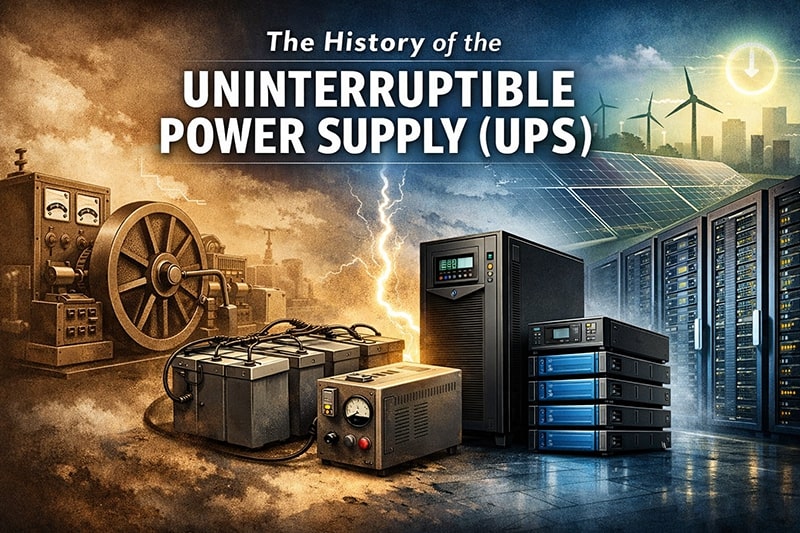
An Uninterruptible Power Supply (UPS) is a critical component in modern electrical and digital infrastructure, designed to provide immediate backup power during utility failures and protect equipment from power disturbances. The history of UPS technology mirrors the evolution of electrical systems, computing, and power electronics, progressing from mechanical energy storage to intelligent, battery-based systems that support today’s data-driven world.
Early Origins: Mechanical Backup Power Systems
The earliest concepts related to uninterruptible power emerged in the early 20th century, when industries began to rely heavily on continuous electrical power. At that time, power grids were unstable, and interruptions were common. To address this challenge, engineers developed mechanical solutions such as motor-generator sets combined with flywheels.
These early systems stored kinetic energy in large rotating masses. When utility power failed, the flywheel continued spinning and provided short-duration power, typically long enough to start a standby generator or allow for an orderly shutdown of sensitive equipment. While effective, these systems were large, noisy, and required extensive maintenance.
The Introduction of Battery-Based UPS Systems
By the mid-20th century, advancements in battery technology enabled the development of battery-based UPS systems. Lead-acid batteries became the primary energy storage medium, offering longer backup times and more predictable performance compared to mechanical systems.
These early battery UPS solutions were primarily used in mission-critical environments such as hospitals, telecommunications facilities, and early computer centers. Although bulky and expensive, they marked a significant shift toward more reliable and scalable power backup solutions.
As UPS applications expanded and power density requirements increased, limitations of lead-acid batteries—such as large size, heavy weight, limited cycle life, and frequent maintenance—became more apparent. This drove the industry to explore alternative battery technologies.
In the late 20th and early 21st centuries, lithium-based batteries began to emerge in UPS applications. Lithium-ion and lithium iron phosphate (LiFePO₄) batteries offered significant advantages, including higher energy density, longer service life, faster charging, and reduced maintenance requirements. These characteristics made lithium batteries especially attractive for data centers, industrial UPS systems, and space-constrained installations.
The introduction of lithium batteries marked an important milestone in UPS evolution, enabling more compact system designs, lower total cost of ownership over the system lifecycle, and improved operational efficiency. Today, lithium battery technology continues to gain adoption as a modern alternative to traditional lead-acid energy storage in UPS systems.
The Solid-State Revolution
The 1970s and 1980s represented a major turning point in UPS history with the rise of solid-state electronics. The introduction of semiconductors, power transistors, and thyristors allowed UPS systems to transition away from mechanical components toward static designs.
This era gave rise to the core UPS topologies still used today:
- Standby (Offline) UPS – Supplies power directly from the utility and switches to battery during outages.
- Line-Interactive UPS – Regulates voltage fluctuations while providing battery backup.
- Online (Double-Conversion) UPS – Continuously conditions power by converting AC to DC and back to AC, offering the highest level of protection.
Solid-state UPS systems were smaller, faster, and more reliable, making them suitable for a wider range of applications.
The Digital Age and Widespread Adoption
The rapid growth of personal computing, networking, and the internet in the 1990s and early 2000s dramatically increased the demand for UPS systems. Even brief power interruptions could result in data loss, system crashes, and costly downtime.
During this period, UPS manufacturers introduced features such as modular scalability, remote monitoring, and network communication capabilities. UPS systems became standard equipment in data centers, financial institutions, manufacturing facilities, and commercial buildings.
Modern UPS Technology and Innovation
In recent years, UPS technology has continued to evolve, driven by efficiency requirements, sustainability goals, and advancements in energy storage. Lithium-ion batteries have emerged as an alternative to traditional lead-acid batteries, offering longer service life, faster charging, higher energy density, and reduced maintenance.
Modern UPS systems also incorporate intelligent monitoring, predictive diagnostics, and integration with energy management platforms. These features enable proactive maintenance, improved reliability, and optimized energy usage.
Transformerless designs, eco-modes, and high-efficiency power converters have further reduced energy losses, making UPS systems more environmentally friendly and cost-effective over their operational lifespan.
The Future of Uninterruptible Power Supplies
As digital infrastructure continues to expand and power quality becomes increasingly critical, UPS systems will remain a foundational technology. Future developments are expected to focus on higher efficiency, smarter control systems, seamless integration with renewable energy, and enhanced resilience for mission-critical applications.
Common UPS kVA Ratings and Applications
- 1 kVA UPS: Desktop computers, home offices, POS systems, routers
- 2 kVA UPS: Multiple PCs, small offices, network switches, CCTV systems
- 3 kVA UPS: Small servers, light server racks, network cabinets, lab equipment
- 5–6 kVA UPS: Medium servers, office server rooms, telecom equipment, industrial controls
- 10 kVA UPS: Data center racks, automation systems, banking systems, medical equipment
- 15–20 kVA UPS: Large server rooms, manufacturing systems, hospital equipment
- 30–40 kVA UPS: Medium data centers, telecom base stations, factory production lines
- 60–100 kVA UPS: Large data centers, industrial plants, oil & gas facilities
- 200 kVA+ UPS: Hyperscale data centers, large hospitals, critical infrastructure
Conclusion
The history of the uninterruptible power supply is a story of continuous innovation, shaped by the growing need for reliable and clean power. From mechanical flywheels to intelligent, battery-based systems, UPS technology has evolved to protect modern society’s most critical operations. As industries and technologies advance, UPS systems will continue to play a vital role in ensuring power continuity and operational stability.