
Reserve capacity (RC) is an important specification used to measure how long a battery can continue supplying power when the charging system fails or when the battery is operating without external charging. It is commonly used for automotive batteries, marine batteries, and deep-cycle batteries to indicate the battery’s ability to provide emergency power.
Definition of Reserve Capacity
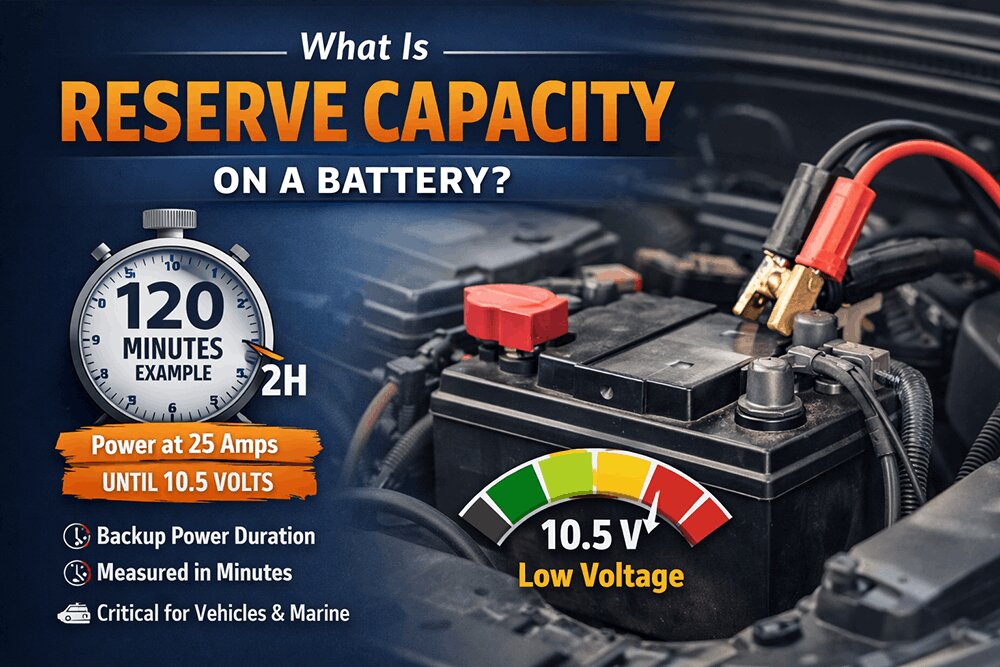
Reserve capacity refers to the number of minutes a fully charged battery can deliver a constant current of 25 amps at a temperature of 25°C (77°F) before the voltage drops to 10.5 volts. This standardized test helps determine how long a battery can power essential electrical systems if the alternator or charging system stops working.
For example, if a battery has a reserve capacity rating of 120 minutes, it means the battery can supply 25 amps of current for approximately two hours before reaching the minimum operating voltage.
Why Reserve Capacity Is Important
Reserve capacity provides valuable information about a battery’s reliability and backup power capability. In vehicles and equipment that rely heavily on electrical components, a higher reserve capacity ensures that critical systems can continue operating even if the charging system fails.
Key benefits of higher reserve capacity include:
- Longer backup power during alternator failure
- Better support for electronic accessories and onboard electronics
- Improved reliability in emergency situations
- Greater ability to handle heavy electrical loads
Reserve Capacity vs Amp-Hour Rating
Reserve capacity and amp-hour (Ah) rating are both used to measure battery capacity, but they represent different performance characteristics.
| Feature | Reserve Capacity (RC) | Amp-Hour (Ah) |
|---|---|---|
| Measurement | Minutes | Amp-hours |
| Test Load | 25 amps constant discharge | Typically 20-hour discharge rate |
| Main Use | Automotive backup power evaluation | General battery capacity measurement |
| Common Applications | Car and marine batteries | Deep-cycle and energy storage batteries |
Typical Reserve Capacity Values
Reserve capacity varies depending on the battery size and design. Larger batteries generally have higher RC ratings because they contain more active material and energy storage capacity.
- Small automotive battery: 60–90 minutes
- Standard car battery: 90–150 minutes
- Large automotive battery: 150–200 minutes
- Deep-cycle marine battery: 180–400 minutes
Applications Where Reserve Capacity Matters
Reserve capacity is particularly important in systems where uninterrupted power is critical, including applications such as Uninterruptible Power Supply (UPS) systems. Vehicles and equipment with high electrical demands rely on batteries with sufficient reserve capacity to maintain operation during unexpected charging system failures, while UPS systems depend on this backup capacity to keep essential devices running during power outages.
Common applications include:
- Automobiles and trucks
- Marine vessels and boats
- Recreational vehicles (RV)
- Backup power systems
- Emergency power applications
How to Choose a Battery with the Right Reserve Capacity
When selecting a battery, it is important to consider both reserve capacity and the electrical demands of the device or vehicle. A battery with higher RC rating can provide longer backup power and better support for modern electronics such as navigation systems, lighting, communication devices, and onboard computers.
Factors to consider include the size of the electrical load, operating conditions, and how critical continuous power is for the application. In vehicles with many electronic accessories, choosing a battery with higher reserve capacity can significantly improve reliability and performance.
Conclusion
Reserve capacity is a key battery specification that indicates how long a battery can continue delivering power when the charging system is unavailable. Measured in minutes under standardized conditions, it provides a practical way to evaluate a battery’s backup capability and overall reliability. Understanding reserve capacity helps users choose the right battery for automotive, marine, and backup power applications where dependable performance is essential.