
If you’ve ever opened a small electronic device — a key fob, a watch, a glucose meter, a calculator — and found a flat, silver coin inside, you’ve encountered a lithium coin cell battery. Two of the most common sizes you’ll encounter are the CR2025 and the CR2032. They look nearly identical, they cost about the same, and they’re often stocked side by side on the same store shelf. But they are not interchangeable — at least not without consequences.
This guide covers everything you need to know about these two batteries: how they differ, where each one is used, whether one can substitute for the other, and how to choose the right cell for your device.
What Are CR2025 and CR2032 Batteries?
Both the CR2025 and CR2032 are lithium manganese dioxide (Li-MnO₂) coin cell batteries. The “CR” designation is an IEC standard prefix: “C” indicates the lithium chemistry category, and “R” indicates a round (cylindrical) form factor. The numbers that follow encode the physical dimensions of the cell.
Here’s how to read the numbering system:
- The first two digits = diameter in millimeters
- The last two digits = height (thickness) in tenths of a millimeter
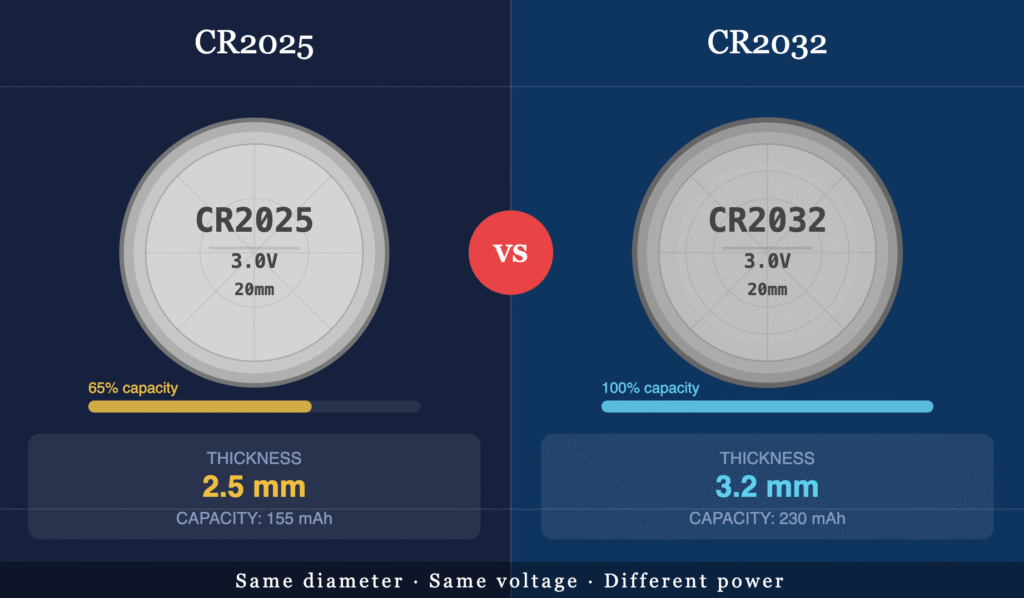
So a CR2025 is 20mm in diameter and 2.5mm thick, while a CR2032 is 20mm in diameter and 3.2mm thick. Same width, different height — that 0.7mm difference is the entire story of why these two batteries are not simply the same product.
CR2025 vs CR2032 — Side-by-Side Specifications
| Specification | CR2025 | CR2032 |
|---|---|---|
| Diameter | 20.0 mm | 20.0 mm |
| Thickness | 2.5 mm | 3.2 mm |
| Nominal voltage | 3.0 V | 3.0 V |
| Typical capacity | 150–165 mAh | 220–240 mAh |
| Chemistry | Lithium manganese dioxide (Li-MnO₂) | Lithium manganese dioxide (Li-MnO₂) |
| Operating temperature | −30°C to +70°C | −30°C to +70°C |
| Shelf life | 8–10 years | 10 years |
| Self-discharge rate | ~1% per year | ~1% per year |
| Weight | ~2.5 g | ~3.0 g |
| IEC designation | CR2025 | CR2032 |
| ANSI designation | 5003LC | 5004LC |
The voltage is identical. The chemistry is identical. The diameter is identical. The only differences are thickness and — as a direct consequence of that extra 0.7mm of electrode material — capacity.
The Capacity Difference: Why It Matters
The CR2032 holds approximately 220–240 mAh of charge, compared to the CR2025’s 150–165 mAh. That’s roughly 30–40% more energy in the thicker cell. In practical terms, this means:
- A device powered by a CR2032 will run 30–40% longer than the same device powered by a CR2025, assuming the same current draw
- For devices with very low current consumption (under 1 µA average), both cells may last years — the difference becomes significant only at higher drain rates
- For devices with moderate drain (a smartwatch with always-on display, a fitness tracker, a computer motherboard with real-time clock), the capacity difference translates directly into months of additional runtime
This is why, when a device is designed around a CR2032, using a CR2025 as a substitute will shorten the battery life noticeably — and in some cases, the reduced thickness means the cell won’t make reliable contact in the battery holder at all.
Physical Fit: The 0.7mm Problem
Because both cells share the same 20mm diameter, the CR2032 is physically wider in only one dimension — its thickness. This creates two scenarios depending on which direction you’re substituting:
Putting a CR2025 in a CR2032 Device
The CR2025 is thinner (2.5mm vs 3.2mm), so it will physically fit in most CR2032 battery holders. However, the thinner cell may not make firm contact with both the positive and negative terminals of the holder. The result is often intermittent contact — the device works fine when you press on the battery but fails randomly during normal use. In some holders with spring-loaded contacts, the spring provides enough tension to compensate and the device works, but with reduced battery life due to the lower capacity.
Putting a CR2032 in a CR2025 Device
This is the more problematic direction. The CR2032 is 0.7mm thicker than the CR2025, and most battery compartments designed for a CR2025 have precisely dimensioned holders. Forcing a CR2032 into a CR2025 slot can damage the holder, crack the battery compartment cover, or permanently deform the spring contacts. Do not attempt this substitution.
Common Devices That Use CR2025
The CR2025 is favored in applications where a slim profile is more important than maximum battery life, or where the device’s power consumption is low enough that the smaller capacity is not a limitation:
- Car key fobs — particularly Toyota, Lexus, Honda, and Acura models
- Thin wristwatches — dress watches and fashion watches prioritizing a slim case
- Fitness trackers and activity bands — some early-generation devices
- Electronic toys and games — button-activated sound or light effects
- Small medical devices — some glucose meters, hearing aid remote controls
- Calculators — particularly slim scientific calculators
- Cameras — some digital camera memory backup circuits
- Credit card-sized tools — thin LED lights, card-format tools
Common Devices That Use CR2032
The CR2032 is the most widely sold coin cell battery in the world and is the default choice for most designers when board space allows the extra 0.7mm of thickness:
- Computer motherboard CMOS battery — nearly universal across desktop and laptop computers for storing BIOS/UEFI settings
- Car key fobs — BMW, Mercedes-Benz, Volkswagen, Ford, and many other brands
- Medical devices — blood glucose meters, digital thermometers, pulse oximeters
- Wristwatches — the majority of digital and quartz analog watches
- Fitness trackers and smartwatches — many entry-level wearables
- Remote controls — for TVs, air conditioners, garage doors, and smart home devices
- Keyless entry systems — building access cards and fobs
- Children’s toys — particularly those with electronic features
- Pet trackers — basic GPS and activity tags
- Candles and LED tea lights
Can You Use CR2025 Instead of CR2032?
This is the most frequently asked question about these two batteries, and the honest answer is: sometimes, but with trade-offs.
If you’re in a situation where you have a CR2025 and your device needs a CR2032, here is the practical reality:
- The voltage is the same (3.0 V), so the device will power on and operate normally
- The capacity is lower (~35% less), so the battery will die sooner
- The contact fit may be unreliable — depending on the holder design, the thinner cell may not sit firmly
- As a short-term emergency substitute, it will work in most cases
- As a permanent replacement, it is not recommended
If the device is critical — a medical device, a security system, a key fob you depend on daily — always use the correct battery. If you’re using a CR2025 as an emergency fix until you can get to a store, fold a small piece of aluminum foil and place it between the battery and the positive terminal to compensate for the thinner profile and ensure solid contact.
Can You Use CR2032 Instead of CR2025?
No — do not attempt this. The CR2032 is physically thicker and will not fit in a CR2025 battery compartment without forcing. Forcing it risks mechanical damage to the holder and potentially to the device’s PCB if the holder is soldered to the board.
CR2025 vs CR2032 — Battery Life Comparison by Device
To make the capacity difference concrete, here are estimated battery life comparisons in real-world devices, assuming a CR2032 lasts its rated service life:
| Device / Application | CR2032 Estimated Life | CR2025 Estimated Life | Difference |
|---|---|---|---|
| Computer motherboard (CMOS) | 5–10 years | 3–7 years | ~35% shorter |
| Car key fob (daily use) | 2–4 years | 1.5–2.5 years | ~35% shorter |
| Digital wristwatch | 3–5 years | 2–3.5 years | ~30% shorter |
| Glucose meter | 6–12 months | 4–8 months | ~35% shorter |
| Remote control (light use) | 2–4 years | 1.5–3 years | ~30% shorter |
| LED tea light (continuous) | 100–150 hours | 65–100 hours | ~35% shorter |
Brand Comparison: Which Manufacturers Make the Best CR2025 and CR2032?
Not all coin cells are created equal. The leading manufacturers produce cells that closely meet rated capacity, maintain stable voltage throughout discharge, and have genuinely long shelf lives. Budget and counterfeit cells often fall significantly short of their stated capacity.
Tier 1 — Premium Quality
- Panasonic — consistently meets or exceeds rated capacity, excellent shelf life, widely available
- Energizer — strong performer in independent tests, good temperature range
- Duracell — reliable capacity and shelf life, particularly strong in the CR2032
- Sony / Murata — Japanese manufacturing quality, good pulse performance
Tier 2 — Good Value
- Maxell — solid performance, slightly lower capacity retention at end of life
- Varta — popular in Europe, generally meets rated specs
- EVE Energy — Chinese manufacturer meeting IEC standards, widely used in industrial applications
What to Avoid
Unbranded batteries sold in bulk online or in discount stores frequently fail to meet rated capacity by 20–40%. For critical devices (medical equipment, security systems, automotive), always use a recognized brand with a visible expiry date printed on the packaging.
Storage and Handling Tips
- Store at room temperature, away from humidity. Coin cells are not damaged by normal ambient humidity, but prolonged exposure to condensation or moisture can corrode terminals.
- Keep the plastic packaging until the battery is needed — it protects the terminals and prevents accidental short-circuits in a drawer or bag.
- Never carry loose coin cells in a pocket with metal objects (keys, coins). Short-circuiting a lithium coin cell generates heat and can cause burns.
- Check the expiry date before purchase. Most CR2025 and CR2032 batteries have a 10-year shelf life from manufacture. A battery already 5–6 years old on the shelf may only have a few years of storage life remaining.
- Keep away from children. Coin cell batteries are a serious swallowing hazard for young children. A CR2032 lodged in a child’s throat can cause severe internal burns within 2 hours due to an electrochemical reaction with tissue. Always store coin cells securely and check that battery compartments on toys and devices are secured with a screw.
Disposal and Environmental Considerations
Lithium coin cells contain lithium metal and manganese dioxide — both considered hazardous materials. They should not be disposed of in household waste in most jurisdictions. Disposal options include:
- Retail battery recycling drop-off points (most electronics retailers and many supermarkets accept them)
- Municipal hazardous waste collection events
- Mail-in recycling programs offered by some manufacturers
Do not incinerate or crush coin cells. Lithium cells can vent flammable gas or rupture if exposed to fire or mechanical damage.
Quick Reference: Which Battery Does My Device Use?
| Device | Likely Battery | How to Confirm |
|---|---|---|
| Toyota / Lexus / Honda key fob | CR2025 | Check inside the fob or owner’s manual |
| BMW / Mercedes / VW key fob | CR2032 | Check inside the fob or owner’s manual |
| Computer motherboard (CMOS) | CR2032 | Nearly universal — look for the round clip on the board |
| Digital wristwatch | Either — check the back | Battery size is usually engraved on the back case |
| Blood glucose meter | Usually CR2032 | Check the device’s user manual |
| TV remote / smart home remote | Usually CR2032 | Open battery compartment |
| Small calculator | CR2025 or CR2032 | Check back of device or manual |
Final Verdict: CR2025 vs CR2032
The CR2025 and CR2032 are not competitors — they are different-sized tools designed for different applications. The CR2032 is the more capable cell: more capacity, longer life, and more universally specified by device designers. The CR2025 exists for applications where the extra 0.7mm of thickness genuinely cannot be accommodated.
The rule is simple: always use the battery size specified for your device. Check the device, check the manual, or check the old battery before going to buy a replacement. The number is printed on every coin cell — it takes five seconds to verify, and it saves you from a dead device at an inconvenient moment.
If you’re ever caught without the right size and need a temporary fix, a CR2025 can stand in for a CR2032 with careful attention to contact — but treat it as a bridge solution, not a permanent replacement. Going the other direction, from CR2025 to CR2032, risks physical damage and should simply never be attempted.