
GPS trackers are only as reliable as their power source. Whether you’re monitoring remote wildlife in Arctic tundra, tracking fleet vehicles across sun-baked desert highways, or managing assets in industrial freezer warehouses, extreme temperatures pose serious challenges to battery performance, power circuitry, and long-term device reliability. This guide walks you through everything you need to know to keep your GPS trackers powered and performing — no matter what the thermometer reads.
Why Temperature Is the Enemy of GPS Power Systems
Most electronic components, including batteries, are engineered to perform optimally within a “comfort zone” of roughly 0°C to 40°C (32°F to 104°F). Step outside that range — in either direction — and you introduce a cascade of performance issues:
- Cold temperatures slow electrochemical reactions inside batteries, reducing available capacity and causing voltage to drop prematurely.
- High temperatures accelerate chemical degradation, increase self-discharge rates, and can trigger dangerous thermal runaway in lithium-based cells.
- Thermal cycling — repeated expansion and contraction — stresses solder joints, connectors, and circuit boards over time, leading to intermittent failures.
Understanding these mechanisms is the foundation for choosing the right power strategy.
Battery Chemistry: Choosing the Right Cell for the Climate
Not all batteries behave the same under thermal stress. The chemistry you select is arguably the single most important decision when powering GPS trackers in extreme environments.
Lithium Thionyl Chloride (Li-SOCl₂) — Best for Cold & Long-Term Deployments
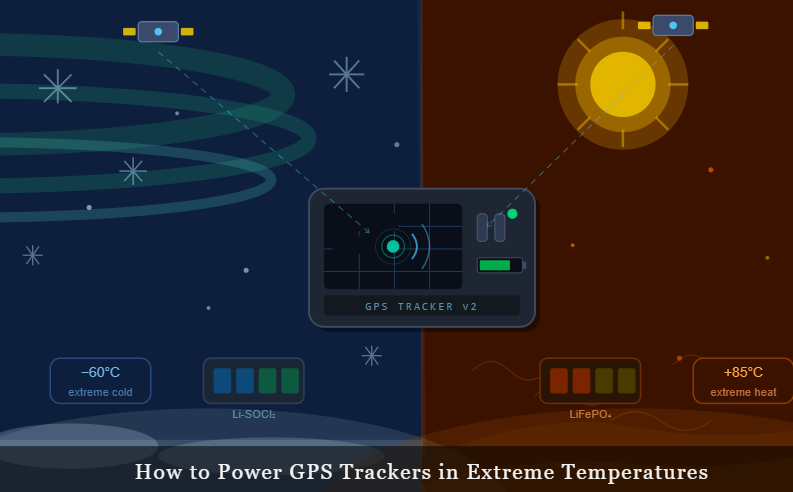
Li-SOCl₂ cells are the gold standard for extreme cold applications. They operate reliably down to −60°C (−76°F), have an exceptional energy density, and a shelf life exceeding 10–15 years. They are non-rechargeable, making them ideal for remote, low-maintenance deployments such as wildlife collars, environmental sensors, and pipeline monitoring in polar regions.
Drawback: They suffer from a “passivation layer” effect after storage — a brief voltage delay on first load. This can be mitigated with pulse-load GPS designs that account for the warm-up period.
Lithium Iron Phosphate (LiFePO₄) — Best for Heat & Rechargeable Systems
LiFePO₄ batteries tolerate high temperatures far better than standard lithium-ion, with a safer thermal threshold and reduced risk of runaway. They operate across −20°C to +60°C (−4°F to +140°F) and are well-suited for solar-charged fleet trackers or industrial applications in hot climates.
Drawback: Lower energy density compared to Li-SOCl₂, and charging below 0°C without a battery management system (BMS) can cause lithium plating and permanent damage.
Standard Lithium-Ion / Li-Po — Moderate Environments Only
Consumer-grade lithium-ion and lithium polymer batteries are the most common but the least suited for extremes. Capacity loss at −20°C can exceed 50%, and sustained exposure above 45°C dramatically shortens lifespan. If your deployment environment regularly exceeds these bounds, consider an upgrade.
Alkaline Batteries — Avoid in Extreme Conditions
Alkaline cells lose up to 80% of their capacity at freezing temperatures and are not recommended for any mission-critical GPS tracking in cold climates. They can leak in heat, damaging the device internally.
Quick Reference: Battery Chemistry vs. Temperature Range
Chemistry Min Temp Max Temp Rechargeable Best Use Case Li-SOCl₂ −60°C +85°C No Arctic / remote deployments LiFePO₄ −20°C +60°C Yes Solar fleet / hot climates Li-Ion / Li-Po −20°C +45°C Yes Temperate / indoor use Alkaline 0°C +40°C No Non-critical, mild environments
Powering GPS Trackers in Extreme Cold
1. Insulate the Power Source
Thermal enclosures are one of the most cost-effective countermeasures. Use closed-cell foam insulation (e.g., neoprene or aerogel-based wraps) around battery packs to slow heat dissipation. In very cold environments, the device’s own operating heat can be a resource — a well-insulated enclosure traps it around the battery.
2. Use Self-Heating Battery Packs
Some industrial LiFePO₄ packs include integrated heating elements that activate at a threshold temperature (typically around −10°C). The heater draws a small amount of stored energy to warm the cell before discharge, preventing voltage collapse and enabling safe recharging in sub-zero conditions.
3. Increase Battery Capacity to Compensate for Loss
If you cannot change battery chemistry, compensate by oversizing. If standard capacity meets your needs at room temperature, plan for 30–50% additional capacity for moderate cold, and up to double capacity for sustained Arctic-level deployments. This buffer accounts for the capacity reduction due to cold.
4. Optimize GPS Polling Intervals
Cold drains batteries faster. Reduce unnecessary power consumption by increasing the interval between GPS fixes when temperature thresholds are crossed. Many modern GPS tracker firmware solutions allow temperature-triggered power profiles — a valuable feature worth prioritizing in device selection.
5. Position Matters
Where possible, mount the tracker in a location that benefits from ambient warmth — for example, inside a vehicle cabin, under an insulated equipment housing, or near a heat-generating component. Avoid exposed, windward-facing positions in freezing environments.
Powering GPS Trackers in Extreme Heat
1. Ensure Adequate Ventilation and Thermal Dissipation
Heat is the primary killer of lithium batteries. Enclosures should be designed to dissipate heat, not trap it. Use vented housings, passive heat sinks, or mount devices in shaded positions. Avoid direct, sustained exposure to sunlight — a black-encased tracker on a metal roof can easily reach internal temperatures of 70°C+ on a hot day.
2. Select High-Temperature Rated Components
Look for GPS trackers and battery packs with explicit operating temperature ratings above 60°C. Industrial-grade devices often carry ratings up to 85°C. Pay close attention to the distinction between “storage temperature” and “operating temperature” in datasheets — storage ratings are typically higher.
3. Integrate a Battery Management System (BMS)
A BMS monitors cell temperature, voltage, and current in real time. In high-heat scenarios, a quality BMS will throttle charging current, trigger overheat cutoffs, and protect cells from thermal runaway — a safety-critical feature for rechargeable systems exposed to desert or industrial heat.
4. Leverage Solar Power with a Thermal Buffer
Solar charging is a natural fit for hot, sunny environments — but solar panels themselves generate heat. Use a charge controller with temperature compensation to adjust the charge voltage curve as temperature rises. Pairing a solar panel with a LiFePO₄ battery and a temperature-compensating MPPT charge controller is a robust solution for outdoor trackers in arid climates.
5. Consider Supercapacitors as a Buffer
In very high-temperature environments where batteries degrade quickly, supercapacitors can serve as a short-term energy buffer — absorbing peak current demands and reducing stress on the primary battery. While supercapacitors have low energy density, they tolerate heat far better than electrochemical cells and have virtually unlimited charge cycles.
Hardwired and External Power Solutions
For vehicles, heavy equipment, or fixed installations, hardwired power is often more reliable than battery-only solutions in extreme environments.
Vehicle Power (OBD-II / Direct Wiring)
Most fleet GPS trackers tap into the vehicle’s 12V or 24V electrical system. This eliminates battery dependency entirely, though a backup battery inside the tracker is still essential for continued tracking when the vehicle is off or the main supply is interrupted. Ensure the backup cell is rated for the expected ambient temperature range of the vehicle’s storage environment (e.g., a fleet parked outdoors overnight in Minnesota winters).
Industrial DC Power Supplies
For fixed asset monitoring in factories, cold storage facilities, or remote industrial sites, hardwired DC supply with a regulated, temperature-rated power adapter is the most stable option. Use wide-input-range converters (e.g., 9–36V input) that handle voltage fluctuations common in industrial environments.
Ruggedized Solar Installations
For off-grid deployments in extreme climates, a solar-plus-storage system with all components rated for the local temperature extremes provides true energy independence. Key components include:
- Monocrystalline solar panel (performs better in low-light cold conditions than polycrystalline)
- MPPT charge controller with low-temperature charging protection
- LiFePO₄ battery bank with self-heating capability
- Weatherproof, UV-resistant enclosure for electronics
Enclosure Design and Environmental Protection
Even the best battery chemistry fails if the enclosure allows moisture ingress, thermal stress, or physical damage. Key specifications to look for:
- IP Rating: IP67 or IP68 is the minimum for outdoor deployments. IP69K is recommended for washdown environments or extreme dust and water exposure.
- Material: Polycarbonate and ABS housings resist UV degradation and handle thermal expansion better than standard plastics. For Arctic deployments, ensure the housing material is rated for cold-temperature impact resistance — many plastics become brittle below −20°C.
- Gaskets and Seals: Silicone seals maintain flexibility across a wider temperature range than rubber. Verify seal ratings match your deployment conditions.
- Condensation Management: Repeated thermal cycling can cause condensation inside sealed enclosures. Use moisture-absorbing desiccant packs and consider pressure-equalization vents (Gore-Tex membrane vents) for long-term deployments.
Firmware and Software Strategies
Hardware alone isn’t enough — the software running your GPS tracker plays a significant role in power management under thermal stress.
Adaptive Power Modes
Configure firmware to automatically reduce reporting frequency, disable non-essential features (e.g., Wi-Fi positioning, accelerometer logging), or enter deep-sleep mode when battery voltage drops below a defined threshold — a reliable indicator that cold temperatures are limiting available capacity.
Temperature Monitoring and Alerts
Many industrial GPS trackers include an onboard temperature sensor. Use this data not just for environmental monitoring, but to trigger power-saving behaviors and send remote alerts before a device goes offline due to thermal battery failure.
Remote Configuration
For deployments in inaccessible locations, the ability to remotely update firmware and adjust power profiles over-the-air (OTA) is invaluable. Rather than dispatching a technician to a remote Arctic installation in winter, a firmware update can recalibrate the tracker’s power behavior to suit changing seasonal conditions.
Maintenance and Field Best Practices
- Pre-deployment conditioning: Store batteries at room temperature before deploying into cold environments. A fully charged, room-temperature battery entering the cold starts with maximum capacity.
- Regular inspection cycles: In extreme environments, plan for more frequent maintenance checks — inspect seals, connectors, and battery charge levels seasonally.
- Use conformal coating: Apply conformal coating to exposed PCBs inside the tracker to protect against condensation, corrosion, and thermal stress cracking.
- Label temperature ratings clearly: When managing large deployments, ensure devices are clearly labeled with their rated temperature range to prevent accidental deployment outside specifications.
- Carry spares: In remote extreme-environment deployments, always maintain a spare device and battery pack. Field replacement is far faster than waiting for repair or return-to-manufacturer.
Summary: Matching Power Strategy to Environment
| Environment | Recommended Battery | Key Considerations |
|---|---|---|
| Arctic / Deep Cold (below −20°C) | Li-SOCl₂ or Self-Heating LiFePO₄ | Insulation, low-power firmware, oversized capacity |
| Cold Climate (−20°C to 0°C) | LiFePO₄ with BMS | Charging protection, condensation management |
| Hot Arid / Desert (>50°C ambient) | LiFePO₄ with thermal cutoff | Ventilation, shade mounting, solar with MPPT |
| Industrial Heat (40–70°C) | Industrial-rated Li-Ion or LiFePO₄ | BMS mandatory, high-temp enclosure rating |
| Vehicle / Fleet (wide range) | Hardwired + LiFePO₄ backup | Voltage regulation, backup for off-hours tracking |
| Remote Off-Grid (any extreme) | Solar + Self-Heating LiFePO₄ | MPPT controller, rugged enclosure, OTA firmware |
Final Thoughts
Powering GPS trackers in extreme temperatures is a discipline that sits at the intersection of electrochemistry, mechanical engineering, and embedded systems design. There is no universal solution — the right approach depends on your specific temperature range, deployment duration, accessibility for maintenance, and budget.
The most common and costly mistake is deploying a standard consumer-grade tracker — designed for temperate conditions — into an environment it was never engineered for. Premature battery failure, device dropouts, and corrupted data are the predictable results. Investing in the right battery chemistry, a properly rated enclosure, intelligent firmware, and a thoughtful power architecture pays dividends in device longevity, data integrity, and operational continuity.
When in doubt, always spec for a wider temperature range than you expect. Environments are rarely as predictable as they appear on paper — and your GPS tracker needs to be ready for the worst day, not just the average one.
Have questions about powering GPS devices in your specific deployment environment? Leave a comment below or reach out to our team for a tailored recommendation.